Quick answer
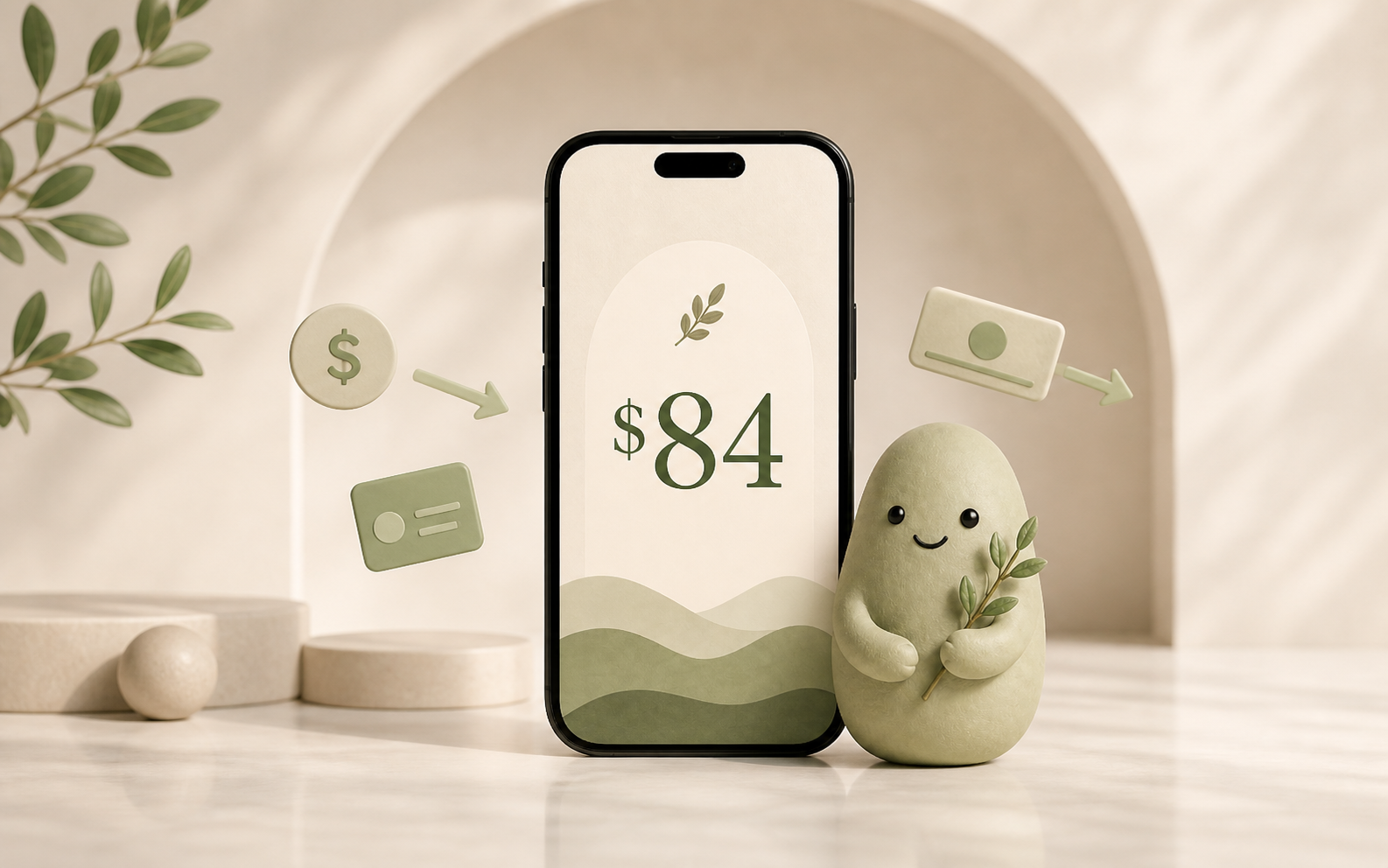
A simple money app for everyday spending decisions gives you one clear number, not dashboards, graphs, or category budgets. Pip calculates your Spendable Cash Today, an estimate of what’s available for today after upcoming bills, protected savings, and pending card charges. It’s a low-pressure checkpoint, not an instruction. Check the number in seconds, decide without second-guessing.
A realistic example
Your bank account shows $2,400, but a $800 rent payment and a $50 phone bill are due in the next ten days. You also plan to set aside $300 for a monthly savings target, and a $120 debit card payment hasn’t cleared yet. The full balance can make you think you have more to spend than you really do.
Here’s how the simple calculation breaks down:
The number you can lean on today is $1,130, not $2,400. That’s everyday spending simplified—one number, no mental arithmetic.
How to estimate it
The logic behind a spendable number is straightforward:
Estimated spendable today = usable cash – near-term bills – protected savings – already-committed card/debit spending – other known obligations.
Start with usable cash (your checking balance, minus holds). Then subtract:
- Upcoming bills you must cover before more income arrives (rent, utilities, subscriptions with known amounts and dates).
- Protected savings you want to exclude from daily spending—Pip calls this your Monthly Savings target.
- Pending charges from debit or credit cards that are authorized but haven’t cleared yet.
- Other known obligations (installments, payment plans, recurring transfers).
Doing this on your own means monitoring every account, checking due dates, and manually deducting each item. Pip automates the whole formula by pulling read-only data from your linked bank accounts and updating Spendable Cash Today as new transactions appear.
What can make this estimate wrong
No daily number is perfect because money moves in real time. A few things can affect the estimate:
- Missing accounts. If you haven’t connected all your checking, savings, and credit card accounts, some spending or bills might not be captured.
- Stale connections. A bank’s feed may occasionally delay syncing, so the number reflects slightly older data.
- Unexpected or irregular bills. Annual subscriptions, medical bills, or forgotten expenses that haven’t appeared in recent history won’t be subtracted yet.
- Timing gaps. A refund that’s been processed but hasn’t posted can make usable cash look lower, while a freshly swiped card may take a day to appear.
These limits are why Pip’s number is a decision-support signal, not financial advice. It’s designed to help you pause and check, not to demand a perfect read on every penny.
How Pip handles it
Pip gives you a spendable number you can check before everyday decisions, without extra steps. After you connect your accounts, Pip uses the same subtraction approach described above. The output is Spendable Cash Today, a single number you see each time you open the app.
Because Pip is read-only, it does not move money, cannot make transfers, and does not store bank usernames or passwords. Your funds stay entirely within your bank’s infrastructure. Pip reads balances and transaction metadata through a trusted aggregation partner, then runs the arithmetic locally.
You don’t set up categories or fill out budget templates. You just check the number. When it’s comfortably high, spending feels less constrained. When it’s lower, the number appears alongside a small, simple character rather than a red alert. Pip is not financial advice; it’s a daily tool that turns a noisy balance into a single, usable signal.
FAQ
How is Pip different from a budgeting app?
Budgeting apps typically ask you to assign every dollar to a category, track spending against limits, or maintain spreadsheets. Pip skips that. It delivers one number that accounts for upcoming bills and savings, so you don’t need to categorize individual expenses.
Does Pip tell me I can’t spend anything?
No. Pip shows a number that’s available for today. If it’s low, that suggests most funds are already spoken for, not that you can’t spend. Many users see a smaller number and decide to hold off on non-essential purchases.
Can I use Pip alongside my existing bank app?
Yes. Pip doesn’t replace your bank or its app; it offers an additional, simplified view. Your bank app still holds your balance, transaction history, and payment tools. Pip’s read-only access gives you a single daily number without changing any bank controls.
What if I have multiple accounts?
Pip works best when you connect all your transaction accounts—checking, savings, and credit cards. That way Spendable Cash Today accounts for money coming in, going out, and already committed.
Source notes
Pip uses a read-only account connection, does not move money, does not store bank usernames or passwords, and is not financial advice. The Spendable Cash Today formula is based on decades of behavioral science about mental accounting and scarcity. Pip adapts these insights into a daily number using only read‑only, aggregated bank data. For the full mechanics, see How the number works. This article is not financial advice—it’s a description of the app’s approach to everyday spending decisions. Updated to reflect Pip’s current methodology as of June 2025.